Publishing more blog posts does not automatically mean better search visibility. I have seen how easily a website can end up with useful articles that barely connect to each other.
That is why I prefer building SEO topic clusters around the questions people actually ask, the problems they need to solve, and the pages a business wants them to discover.
The goal is not to create 20 articles around one keyword. It is to build a connected resource that makes sense to readers, search engines, and increasingly, AI-powered search experiences.
Here is how I approach it.
What Are SEO Topic Clusters?
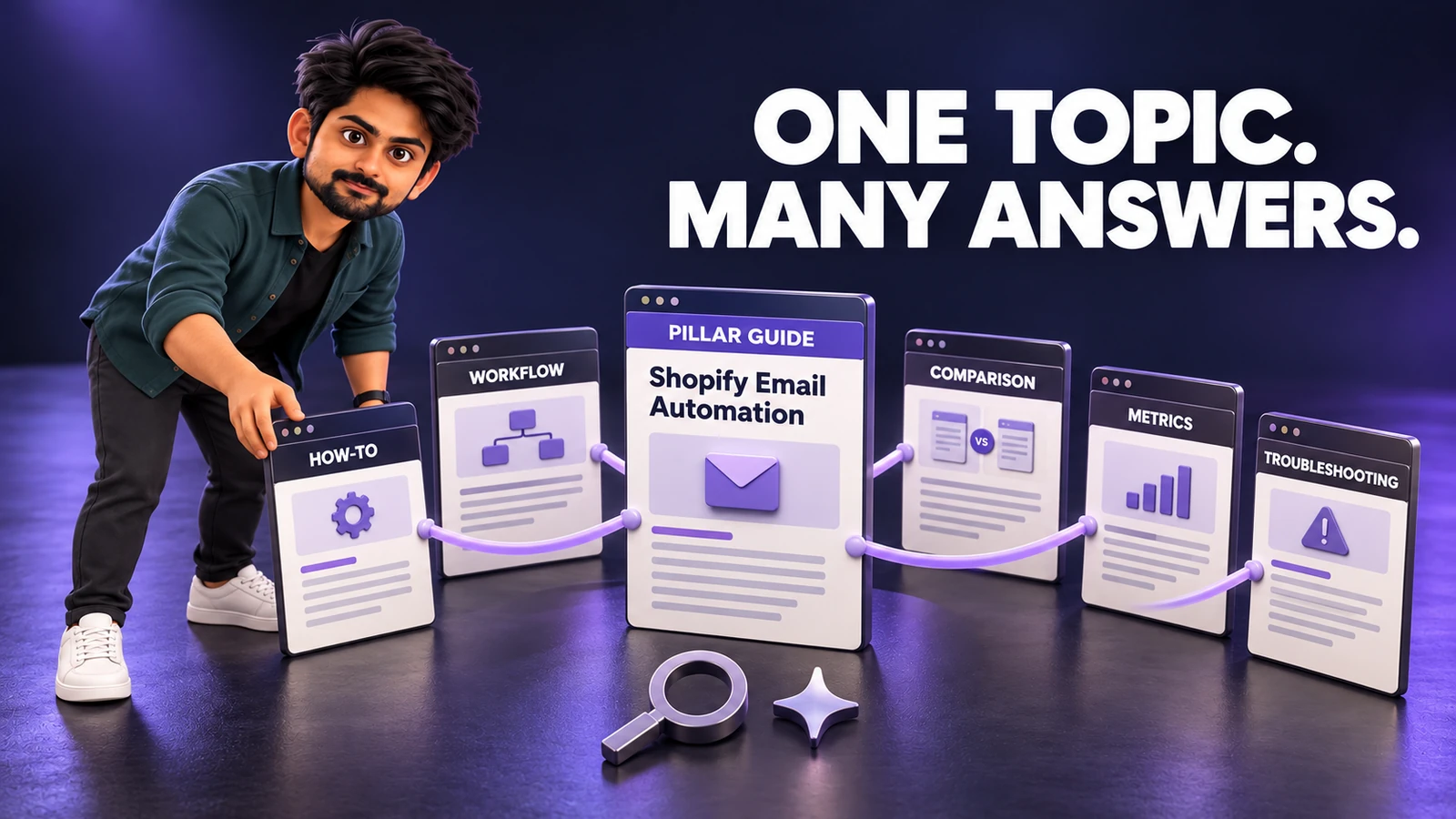
A topic cluster is a group of closely related pages organized around one main subject.
Usually, there is a pillar page covering the broad topic and several supporting pages answering more specific questions. Contextual internal links connect them.
Think of the pillar as the starting point, not a page that tries to answer everything. Supporting articles go deeper where readers need instructions, comparisons, examples, or troubleshooting.
A topic cluster is not a shortcut to rankings. It is a practical way to organize useful content and make the relationships between pages clearer.
1. I Start With a Real Topic, Not a List of Keywords
Before opening a keyword research tool, I ask:
- What problem does this business help people solve?
- What would someone want to understand before choosing its product or service?
- Which questions appear during setup, comparison, or troubleshooting?
- Can we genuinely provide a better answer than what already exists?
For a Shopify-focused business, Shopify email automation could be a useful central topic. But I would only choose it if the business has relevant expertise, products, or services.
I also look through Google Search Console, existing website content, customer questions, product documentation, and search results.
Search volume is useful. Relevance and intent matter more.
2. I Group Questions by Search Intent
This is where many topic-cluster plans become messy.
Two keywords may look different but deserve the same page. Meanwhile, similar-looking searches may have completely different intentions.
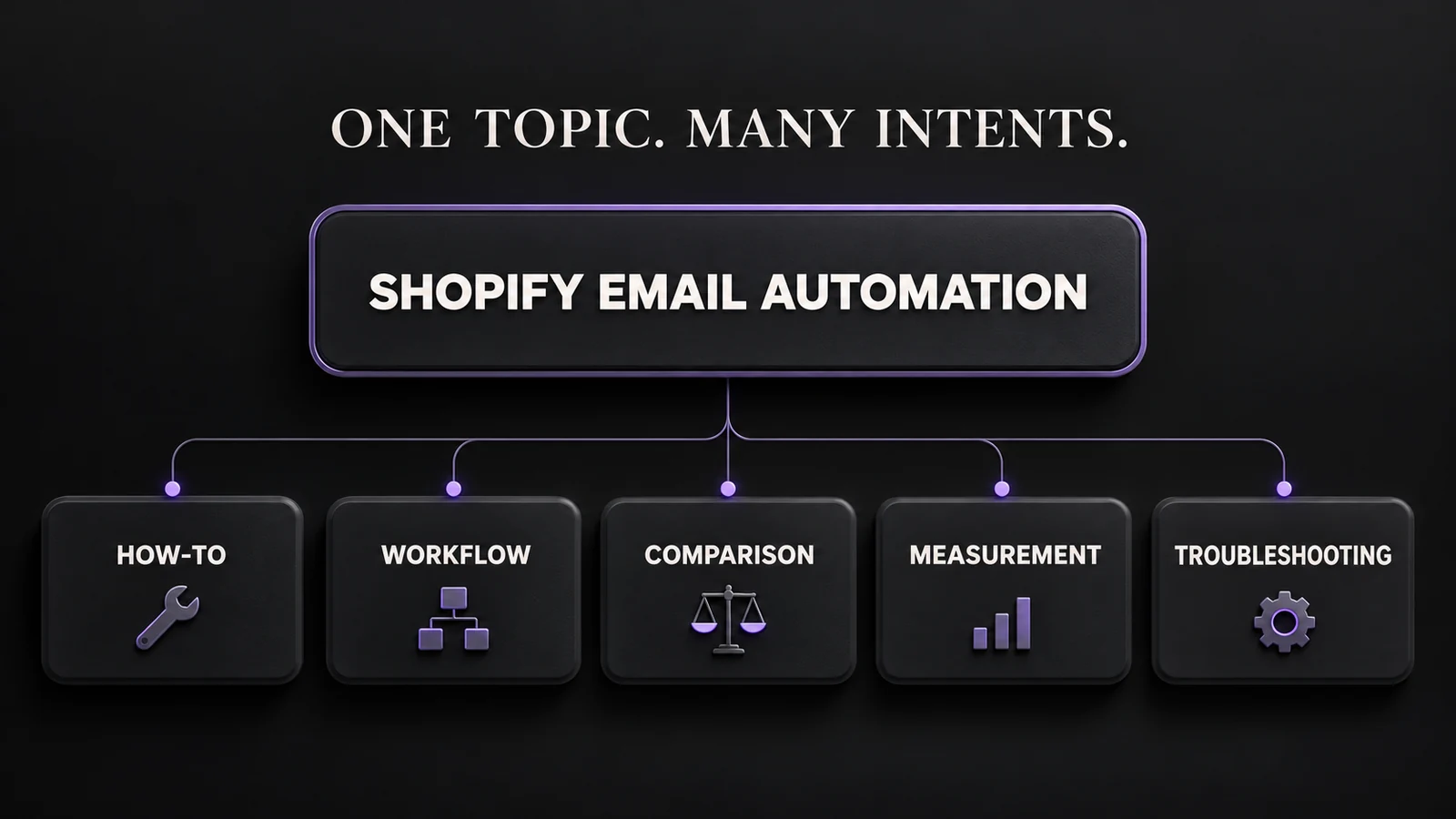
For the Shopify email automation example, I might map the cluster like this:
- Pillar: Shopify Email Automation: A Practical Guide
- How-to: How to Set Up Abandoned Checkout Emails
- Workflow: Welcome Email Automation for New Customers
- Comparison: Built-In vs Third-Party Email Automation Tools
- Measurement: Email Automation Metrics Worth Tracking
- Troubleshooting: Why an Email Automation Is Not Triggering
Each page has a distinct job. The pillar explains the overall system, while supporting content answers narrower questions properly.
I check the actual search results before deciding whether a topic needs its own URL. Creating separate articles for every keyword variation often produces repetition and keyword cannibalization.
3. I Audit Existing Content Before Writing Anything New
I do not assume every cluster requires fresh articles.
Sometimes the website already has most of the information. The problem is that it is scattered across blogs, service pages, help articles, and outdated resources.
I review which pages are indexed, which queries bring impressions, where content overlaps, and which pages have useful backlinks or conversions.
Then I decide what to keep, refresh, combine, or create.
This also connects to something I discussed in why business websites become hard to manage. Publishing without maintaining content structure eventually creates unnecessary complexity.
4. I Build a Useful Pillar Page
The pillar page should help someone understand the subject and choose where to go next.
I normally want it to cover the main concept, who it is for, the important decisions, the overall process, and links to deeper guides.
But I do not make it unnecessarily long just to look authoritative.
If a reader needs a detailed setup tutorial, that belongs on the supporting page. If they want a broad overview, the pillar should answer that without forcing them through ten different articles.
One strong page is more useful than five thin ones repeating the same advice.
5. I Connect the Pages With Intentional Internal Links
A cluster is incomplete if the articles never reference each other.
I link the pillar to relevant supporting pages, link those pages back when useful, and connect related supporting articles where the reader would naturally want the next answer.
The anchor text should describe the destination. Something like “abandoned checkout email setup” is more helpful than “click here.”
Google’s internal linking guidance reinforces this: links help users and Google discover related pages and understand their context.
I also check that important pages are not orphaned, and that links lead directly to working URLs.
6. I Write for People First, While Making Answers Easy to Find
AI search is changing how people discover information. I have already shared my thoughts on why Google is becoming more than a traditional search engine.
Google says AI Overviews and AI Mode may run multiple related searches to develop answers. That makes broad topical coverage worth thinking about.
But it does not mean creating a separate page for every question an AI system might ask.
My preference is straightforward: clear headings, direct answers, accurate explanations, useful examples, and specific information that generic articles cannot offer.
For software companies, that might include real integration steps, feature limitations, screenshots, or troubleshooting details. It is also part of the thinking behind why I’m building Decodability.
Google’s 2026 guidance for AI search emphasizes original, useful content and established SEO fundamentals. There is no special schema or magic AI formatting trick that guarantees citations.

7. I Make Sure Search Systems Can Access the Cluster
Even well-planned content will struggle if important pages cannot be crawled or indexed.
I check descriptive URLs, canonical tags, sitemap inclusion, internal links, mobile usability, and whether essential text is accessible without technical barriers.
For WordPress websites, these checks overlap with my technical SEO guide for WordPress.
Good content architecture and technical SEO need to work together.
8. I Measure the Cluster as a System
I do not judge a cluster only by whether its pillar ranks for one keyword.
I look at:
- Search Console impressions, clicks, and queries across the cluster
- Indexing and performance of individual supporting pages
- Internal journeys to relevant service or product pages
- Enquiries, sign-ups, or other meaningful conversions
Google also introduced a Generative AI performance report in Search Console for AI Overviews and AI Mode impressions. When enough data is available, I would use it alongside normal search reporting.
I review what readers still need, update weak pages, and add new content only when there is a genuine gap.
Mistakes I Try to Avoid
The biggest mistakes are creating overlapping pages, chasing keywords unrelated to the business, publishing generic AI-written explanations, and treating internal linking as an afterthought.
Another is expecting instant results.
Topic clusters are a content strategy, not a guarantee of rankings or AI mentions. Their value comes from making a website genuinely more useful and easier to navigate over time.
Frequently Asked Questions
What is an SEO topic cluster?
It is a set of related pages built around one core topic, usually with a broad pillar page and more detailed supporting articles connected through internal links.
How many articles should a topic cluster have?
There is no fixed number. Start with the pages needed to answer distinct, important questions. A focused cluster with five useful pages can be better than 25 repetitive ones.
Do topic clusters improve visibility in AI Overviews?
They can support clear content organization and comprehensive coverage, but they do not guarantee inclusion. Google still emphasizes indexable, original, helpful content and its normal SEO fundamentals.
Should I create the pillar page first?
Not necessarily. You can organize and connect existing supporting content, then create or improve the pillar. I care more about the final structure than the publishing order.
How do I avoid keyword cannibalization?
Give each page a distinct search intent. If two articles answer essentially the same question, consider improving or combining them instead of making both compete.
Final Thoughts
For me, SEO topic clusters are about connecting knowledge, not manufacturing more pages.
Start with a topic that matters to the business. Understand the questions behind it. Build the right pages, connect them logically, and keep improving them.
That approach gives readers a better experience and creates a stronger foundation for both traditional SEO and AI search visibility.