There is a big difference between hitting a limit while casually playing around with an AI tool and hitting a limit while you are halfway through actual work.
That is what makes OpenAI’s latest Codex change interesting to me.
On August 25, 2026, OpenAI brought back the five-hour usage window for ChatGPT Plus users across Codex and ChatGPT Work. The restriction had been temporarily lifted for several weeks, leaving users mainly dealing with their weekly allowance instead.
Now the shorter window is back.
And as someone who works in development, I think the bigger issue here is not simply that OpenAI has limits.
Of course there are going to be limits.
Running these models costs a ridiculous amount of compute, especially when we are talking about agents reading large codebases, reasoning through problems, running commands, checking files and continuing through longer tasks.
My problem is something slightly different.
When AI becomes part of your actual workflow, unpredictable limits start affecting the way you work.
First, the “5-hour limit” is slightly confusing
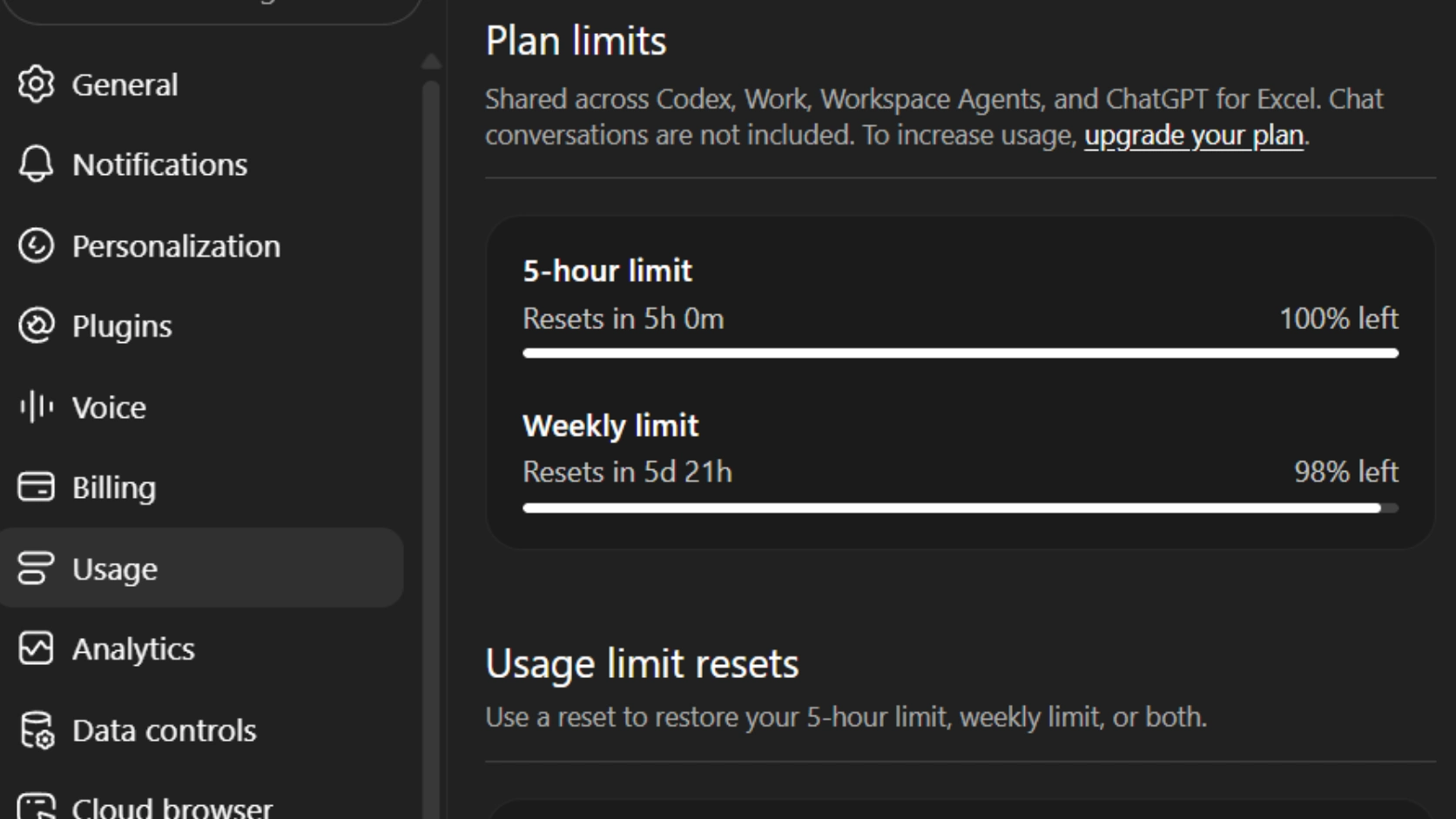
Reading some of the headlines, you could easily assume that ChatGPT Plus now gives you five hours of Codex and then stops.
That is not exactly how it works.
OpenAI uses a usage allowance that operates within a five-hour window, alongside a weekly allowance. How quickly you consume that usage is not fixed.
According to OpenAI’s current documentation, usage depends on things like the model you choose, the complexity of the task, the amount of context involved, reasoning, speed, tools and where the task runs. A large coding task can therefore consume considerably more of your allowance than a small edit.
So you are not necessarily getting five continuous hours of coding.
You are getting an allowance that refreshes on that cycle.
That distinction matters.
Because if I know I have exactly five hours available, I can plan around five hours.
If I know I have some invisible amount of compute that may disappear faster depending on what I ask the agent to do, planning becomes harder.
Why did OpenAI bring the limit back?

OpenAI’s explanation actually makes sense.
Thibault Sottiaux, an engineering lead working on Codex and ChatGPT, explained that the five-hour window helps OpenAI distribute compute demand instead of allowing huge amounts of usage to become concentrated into shorter periods.
There was another interesting reason too.
Apparently, while the shorter limit was temporarily disabled, some Plus users were accidentally consuming their entire weekly allowance in one long session. They would then discover that they had basically used up their Codex access for the rest of the week.
So from OpenAI’s perspective, the five-hour window does two things.
It manages infrastructure demand, and it prevents some people from destroying their weekly allowance without realizing it.
Fair enough.
I can understand both reasons.
But solving one user experience problem can create another one.
Codex is slowly becoming a work tool, not an experimental feature
This is where my opinion changes.
A year or two ago, I probably would not have cared much about something like this.
AI coding was still something you experimented with.
Generate a function.
Fix some CSS.
Explain an error.
Maybe write a small script.
Today, tools like Codex are moving much deeper into development workflows.
They can inspect a project, understand files, make changes across a codebase, run commands, review their own output and work through tasks that previously required a developer to manually jump between multiple files and tools.
OpenAI itself describes Codex as an agent for writing, reviewing and shipping code.
That changes the relationship we have with the tool.
I have written before about why I think vibe coding is genuinely useful but still does not replace understanding the fundamentals.
And this situation highlights another side of the same change.
Once developers start building their workflow around an AI agent, the reliability of access becomes part of the product.
Imagine assigning Codex a larger debugging task.
It reads the repository.
Finds the issue.
Starts modifying several files.
Runs tests.
Something fails.
It investigates again.
And somewhere in the middle of all of this, your usage window runs out.
Technically nothing is broken.
You can wait for the allowance to reset, or where available, buy additional credits.
But your workflow has still been interrupted.
That is the frustrating part.
A weekly limit is easier to understand than two limits at once
Personally, I actually preferred the idea of a weekly allowance.
You have a pool.
Use it carefully.
If you burn through it too quickly, that is your problem.
At least the mental model is simple.
Now Plus users potentially need to think about both the shorter five-hour allowance and the larger weekly allowance. OpenAI’s documentation also says that Codex, ChatGPT Work and other supported agentic features can draw from the same overall allowance when available on the plan.
You could theoretically have weekly capacity remaining but still need to stop because you exhausted the current five-hour window.
That makes the product harder to mentally budget.
And I think we are going to see this problem more often as AI subscriptions evolve.
For years, software subscriptions were simple.
Pay monthly. Use software.
AI changes that because every serious interaction has an ongoing computational cost.
A person using an ordinary design tool for eight hours does not necessarily cost the software company dramatically more than someone using it for one hour.
An AI agent is different.
More reasoning, more tokens, larger context, longer tasks and stronger models all cost something.
So I understand why completely unlimited AI subscriptions are difficult to offer.
But that means transparency becomes extremely important.
Plus is getting stuck between casual use and professional use

This is probably the most interesting part of the whole situation.
ChatGPT Plus has always been an incredibly accessible way to get access to powerful AI.
But Codex creates a strange problem.
The same Plus subscriber could be someone occasionally asking AI to fix a WordPress snippet, or a developer asking an agent to analyze an enormous production codebase.
Those are completely different usage patterns.
And trying to serve both under one simple subscription becomes difficult.
For a casual Codex user, the restored five-hour window may barely matter.
They might never reach it.
For someone running longer agentic development sessions every day, it could become annoying very quickly.
OpenAI has said that the five-hour restriction will remain disabled for its higher-priced Pro tiers for the upcoming months, although that policy can obviously change later.
That gives heavier users another option.
There is also the ability for eligible users to purchase additional credits after their included usage is exhausted instead of immediately upgrading their subscription.
Which is useful.
But the whole thing is slowly starting to look less like a traditional software subscription and more like a compute plan.
And maybe that is exactly where AI software is heading.
I would rather have clearer limits than pretend everything is unlimited
I do not think the solution is simply:
“OpenAI should make Codex unlimited.”
That sounds great until millions of people start running huge autonomous coding jobs at the same time.
There has to be some kind of resource management.
What I would rather see is much better visibility.
Tell me clearly how much I have left.
Tell me approximately how expensive a task is likely to be before I start it.
Show me what consumed most of my allowance.
Make it obvious which models are burning usage faster.
Warn me when I am about to hand a massive job to the agent with very little capacity remaining.
OpenAI already provides usage information and reset details in its usage interfaces, but as these agents become more central to professional work, I think that information needs to become almost impossible to misunderstand.
People should not need to study pricing pages before deciding whether they can ask an AI agent to finish debugging their application.
Model choice is probably going to matter more too
Another thing this changes is how we think about choosing AI models.
Using the strongest model for absolutely everything makes less sense when every task consumes from a limited pool.
Sometimes you need the best reasoning available.
Sometimes you just need a basic code change.
I already think about this with regular ChatGPT, which is why I wrote a separate guide explaining how I choose between GPT-5.6 Sol, Terra and Luna.
The same mindset becomes even more useful inside agentic workflows.
Use heavier reasoning when the problem actually deserves it.
Use lighter models for routine work when they are good enough.
Not because you should constantly obsess over every token.
Just because wasting the most expensive reasoning on a basic task is increasingly unnecessary.
The real issue is dependence
This entire discussion becomes more important because AI agents are getting good enough for us to depend on them.
That is actually a compliment to Codex.
Nobody gets angry when a useless tool reaches its usage limit.
People get angry when a tool they genuinely rely on suddenly stops in the middle of something important.
That tells you how far AI coding has come.
The five-hour window itself is not some disaster.
Plus users still have access to Codex.
There is still a weekly allowance.
Additional credits may be available.
Higher plans exist for heavier usage.
I understand OpenAI’s infrastructure argument too.
But the expectations around AI products are changing very quickly.
We are moving from:
“Wow, this thing can write code.”
to:
“This thing is part of how I write code.”
Those are very different expectations.
Once an AI agent becomes part of the working environment, predictable access, understandable limits and transparent usage become almost as important as how intelligent the model itself is.
And I think that is the bigger story behind this change.
The better these agents become, the less acceptable unexpected interruptions will feel.
Not because users expect infinite compute.
Because once a tool becomes part of real work, we need to know when we can actually rely on it.
Sources Used
The core change is well supported across the three articles you provided: OpenAI restored the shorter usage window for Plus on August 25 after temporarily lifting it, while weekly limits continue to exist.
OpenAI Help Center, “Using Codex with your ChatGPT plan”
Used for the current explanation of Codex, shared agentic usage, factors affecting consumption, reset information and usage dashboards. OpenAI Codex plan documentation
OpenAI Help Center, “Using Credits for Flexible Usage in ChatGPT”
Used to verify that eligible Plus users can purchase credits to continue supported agentic usage after included limits are reached. OpenAI flexible usage documentation
9to5Mac, “OpenAI restores 5-hour Codex and Work limits for ChatGPT Plus users”
Used for Sottiaux’s explanation of compute smoothing, users accidentally exhausting weekly usage, the August 25 restoration and the temporary Pro exemption. 9to5Mac coverage
TechRepublic, “OpenAI Brings Back 5-Hour Codex Limit for ChatGPT Plus”
One of your supplied sources. Used to cross-check the August 25 change and its practical implications for developers. TechRepublic article
Ground News, “OpenAI restores 5-hour Codex and Work limits for ChatGPT Plus users”
One of your supplied sources. Useful for comparing how multiple publications reported the same change. Ground News coverage
Notebookcheck, “OpenAI abruptly restores harsh 5-hour Codex and Work limits for ChatGPT Plus”
One of your supplied sources. Used to cross-check the temporary removal, return of the shorter window and impact on heavier users. Notebookcheck article