More than 1,000 AI agents. Eight days of work. And a prototype operating system that actually boots on a laptop.
That, to me, is more interesting than another model topping a benchmark table.
On November 9, 2026, Anthropic released Claude Fable 5.2 and Claude Mythos 5.2. Of course, there are better benchmark scores, faster responses, and a price cut. We hear those things with practically every major AI launch now.
But building an operating system from an empty folder, with AI agents coordinating the development, testing, and fixes? That’s a slightly different conversation.
I am not saying Claude has suddenly replaced an entire engineering team. The operating system was a prototype, and the experiment ran for eight days. Still, it made me curious about how much complicated work we can realistically hand over to these models.
Anthropic’s official announcement, model documentation, and benchmark results tell an interesting story. Here is what actually stood out to me.
The Coding Improvements Are Hard to Ignore
As someone who works in web development and uses AI for technical work, this is the part I care about most.
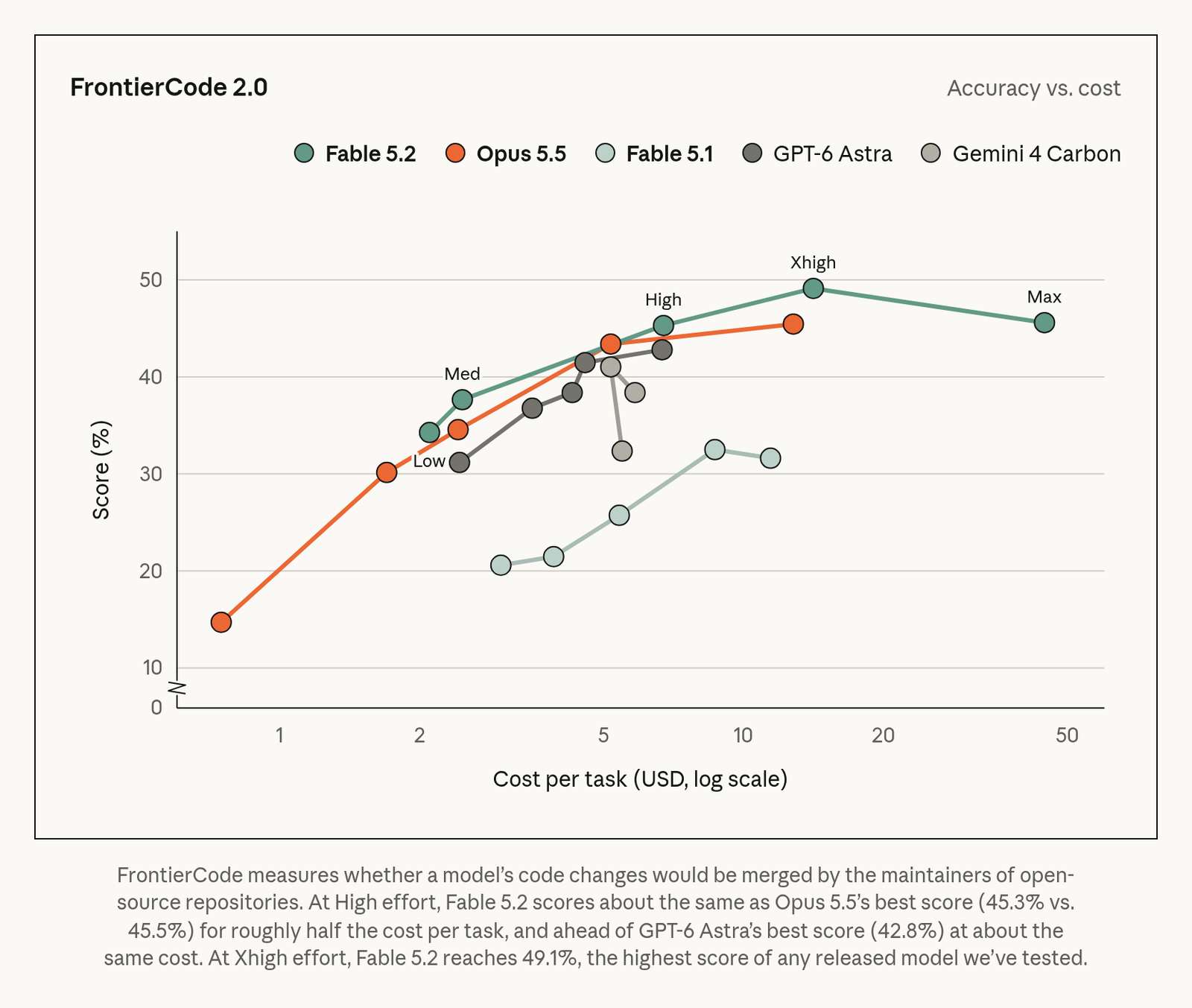
Anthropic reports that Fable 5.2 scored 49.1% on FrontierCode 2.0, compared with 32.4% for Fable 5.1. On FrontierSWE v2, it reached 69.9%, up from 56.3%.
Those are meaningful improvements. But before declaring it the best coding model, there is a detail worth noticing: the headline FrontierCode result uses Xhigh reasoning effort. That is not the default setting, and it affects cost.
Anthropic also says an earlier version of Fable 5.2 helped migrate a production service from Python to Rust, making it start about 26 times faster. And then there was that eight-day operating system experiment with over 1,000 agents.
These examples interest me more than a model answering coding questions correctly. Getting a messy project to a working result involves planning, debugging, checking your own mistakes, and knowing when something is not finished.
That is exactly where AI development tools can still frustrate me. Writing the first version of the code is often the easy part. Making sure everything actually works is another story.
And Then There Are the Science Claims
Some of Anthropic’s demonstrations are honestly quite wild.
The company says Fable 5.2 completed calculations related to two open problems involving black holes and designed three working electronic devices, including a USB speakerphone.
It also used a team of AI agents to formalize a proof of Fermat’s Last Theorem in 30 hours. To be clear, it did not discover a new proof. It translated an existing mathematical proof into a format a computer could check step by step.
I would still wait for independent scrutiny of the research claims. A company announcement is not the same thing as a scientific consensus.
But the range of work is fascinating. We are talking about software, hardware, mathematics, and research, all in one release.
Fable and Mythos Are Not Two Different Brains
The names can be confusing, so here is the simple explanation.
Claude Fable 5.2 and Mythos 5.2 share the same underlying model. The difference is mostly about what Anthropic allows them to do.
Fable is generally available, but it has stronger restrictions around sensitive cybersecurity and biological tasks.
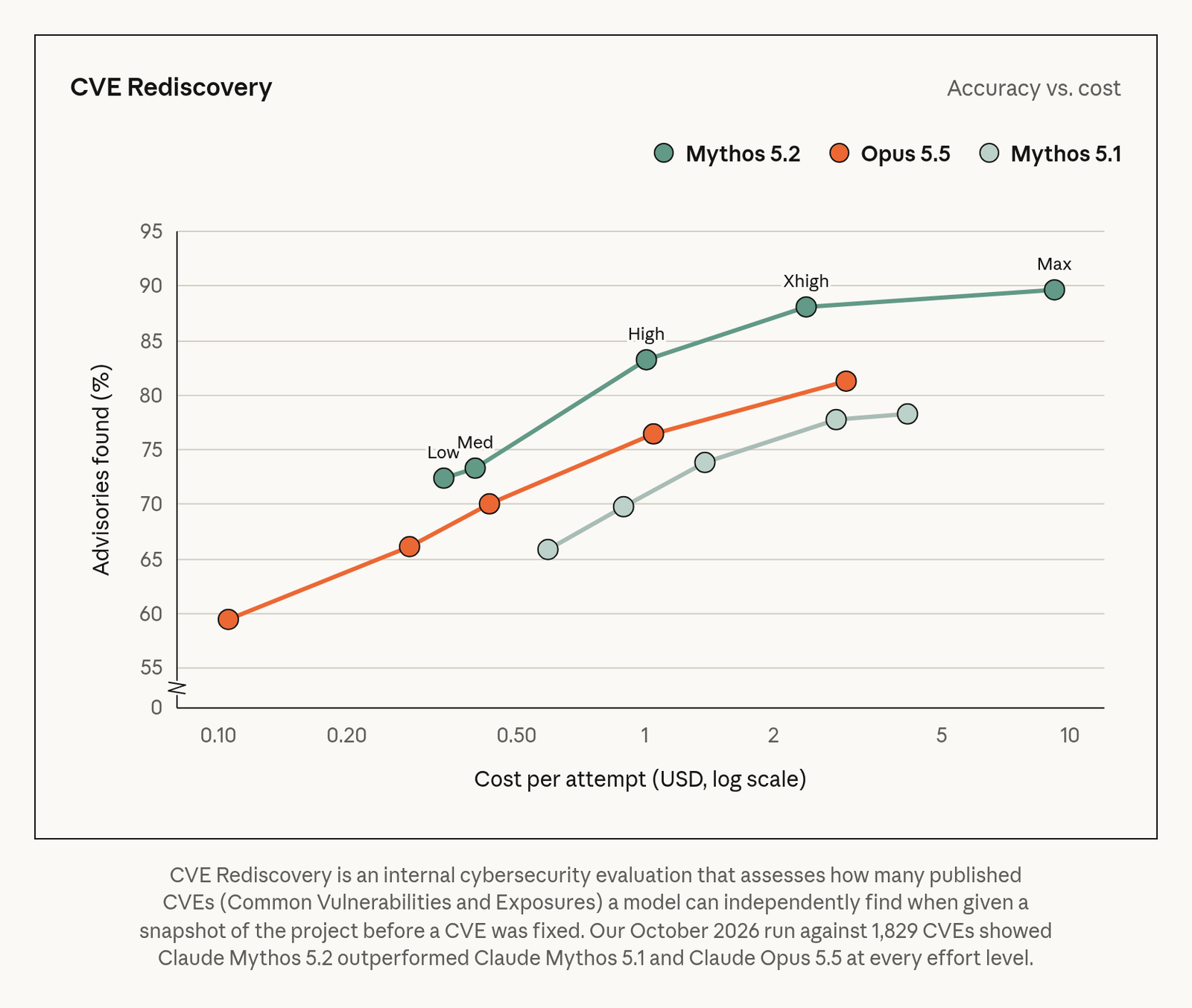
Mythos is intended for verified cybersecurity and life sciences organizations. In Anthropic’s internal vulnerability rediscovery test, Mythos 5.2 found 89.6% of the tested known vulnerabilities, up from 78.3% for Mythos 5.1.
That is impressive, but it is an internal evaluation, not a guarantee that Mythos will find nine out of ten bugs in a real application.
There is also a privacy consideration: these models generally require 30-day data retention for safety monitoring, with exceptions for specifically authorized customers. If your work involves confidential client data, this deserves attention before you start uploading files.
The 20% Price Cut Sounds Great. But Is It Actually Cheaper?
This was probably my second-biggest takeaway.
Anthropic reduced standard API pricing from $10 to $8 per million input tokens and $50 to $40 per million output tokens. Both Fable 5.2 and Mythos 5.2 share those rates.
There is also a Fast mode that can generate tokens up to 2.5 times faster, but the API rates double to $16 input and $80 output per million tokens.
And here is where it gets interesting.
Claude Opus 5.5 costs $4 input and $20 output per million tokens. So Fable is still twice as expensive on the standard token rates, even after the price cut.
But an expensive model can sometimes finish a difficult task with fewer attempts. Anthropic’s own FrontierCode testing showed Fable 5.2 at High effort achieving roughly the same score as Opus 5.5 at Max effort for about half the cost per task.
That is why I would not compare models purely on the price per million tokens. I would compare what it costs to finish the job properly.
I made a similar point in my earlier article about Codex usage limits and predictability. Once AI starts doing serious work, usage and cost become part of the decision, not just model intelligence.
Would I Actually Use Fable 5.2?
Yes, but definitely not for everything.
For a normal WordPress change, a short email, basic SEO work, or a small CSS fix, I would still start with a lighter and cheaper model. I do not see the point of paying for maximum reasoning when the task is straightforward.
Fable 5.2 becomes much more interesting when I have a difficult bug, a large codebase to understand, a complicated migration, or a project where an AI agent needs to keep working through multiple stages without losing the plot.
That is where I would test it against Opus 5.5 and other models, using the same real task rather than just accepting launch-day benchmarks.
I would not pretend the launch-day demos tell us exactly how reliably it handles those jobs. We will learn much more once developers have spent time pushing it beyond the demos.
In my earlier comparison of GPT-6 Astra and Claude Fable 5.1, I wrote about AI moving from answering questions to doing actual work. Fable 5.2 is another step in that direction.
But my question is becoming more practical now.
Can I give an AI model one of those complicated development tasks I have been putting off, let it work, and come back to something that genuinely needs only a careful review?
If it can do that consistently, I will happily pay more for the right tasks.
If it cannot, another impressive benchmark score will not change my mind.
Anyway, until next time. Stay Strong and Keep Learning.
– Amar Karthik