Every few months now, we get another AI model launch claiming to be smarter, faster, better at coding, better at reasoning, better at benchmarks, or basically better at everything.
And yes, I still open these announcements and immediately look at the benchmark tables.
Obviously.
But I genuinely think benchmarks are slowly becoming the less interesting part of these launches.
OpenAI released GPT-6 Astra on September 3, 2026, and just two days earlier Anthropic released Claude Fable 5.1 and Claude Mythos 5.1. Both are major releases, and both companies have published some very impressive numbers.
But after going through both announcements properly, one thing stood out to me.
These models are becoming less like chatbots and more like workers.
That is the actual story here.
We are moving away from:
Ask AI something → get an answer → do the work yourself
towards:
Give AI a goal → let it research → open tools → write code → test things → fix problems → use software → produce the finished work
And I think that change is much bigger than another few percentage points on a benchmark.
This article is based on the official OpenAI and Anthropic information available on September 4, 2026, along with currently available independent testing. These models are brand new, so real-world comparisons will obviously become clearer over the next few weeks.
GPT-6 Astra Is OpenAI Going Much Deeper Into Agents
OpenAI describes GPT-6 Astra as its most capable model so far, specifically highlighting computer use, browsing, software engineering, professional work, science and cybersecurity. Astra is initially rolling out to selected organizations, followed by ChatGPT Plus, Pro, Business and Enterprise users, as well as API and cloud availability.
But the part that caught my attention was computer use.
Astra can actually operate software
GPT-6 Astra can work directly with computer interfaces to do things such as:
- fill online forms
- update CRM records
- organize calendars
- research through a browser
- work inside document editors
- analyze data
- create websites
- perform frontend QA
- install software
- test software
- troubleshoot things happening on screen
OpenAI reports that in its OSWorld 2.0 latency simulation, Astra scored 72.6% while taking roughly 40 minutes per task, compared with GPT-5.6 Sol at 65.7% and roughly 75 minutes. That works out to around 47% less time in that specific evaluation setup.
That is what I mean when I say the chatbot itself is becoming less important.
A chatbot tells you how to update something in your CRM.
An agent opens the CRM and updates it.
Those are very different things.
Astra Looks Particularly Strong for Developers
As someone who uses AI quite heavily for development, this is probably the section I personally care about the most.
OpenAI is positioning Astra as its strongest software engineering model yet. On Terminal-Bench 4.0, OpenAI reports Astra at 57.9%, compared with 55.8% for Claude Fable 5.1 and 37.3% for GPT-5.6 Sol. On its internal database migration evaluation, Astra scored 63.9%, compared with 57.8% for Fable 5.1.
But again, I care more about how the model actually works than whether it wins one benchmark.
One particularly interesting Codex improvement is the way Astra handles extremely long development sessions.
Previously, when a model filled its context window during a long debugging session or large refactor, the system might compress previous information into summaries. The problem is obvious: summaries can drop little details.
Maybe an earlier fix failed for a specific reason.
Maybe a test produced one weird result three hours ago.
Maybe there was one requirement buried somewhere in an older conversation.
With Astra, Codex can preserve notes across context windows, while older context remains searchable. That means Astra can go back and find previous requirements, tool outputs and test results instead of relying entirely on a compressed summary.
For long-running coding agents, that could be much more useful than simply increasing raw context size.
I have already written about why I still think coding fundamentals matter even when vibe coding gets ridiculously good.
Models like Astra make vibe coding much more capable.
They do not make understanding what the model is doing completely irrelevant.
Then Anthropic Released Claude Fable 5.1
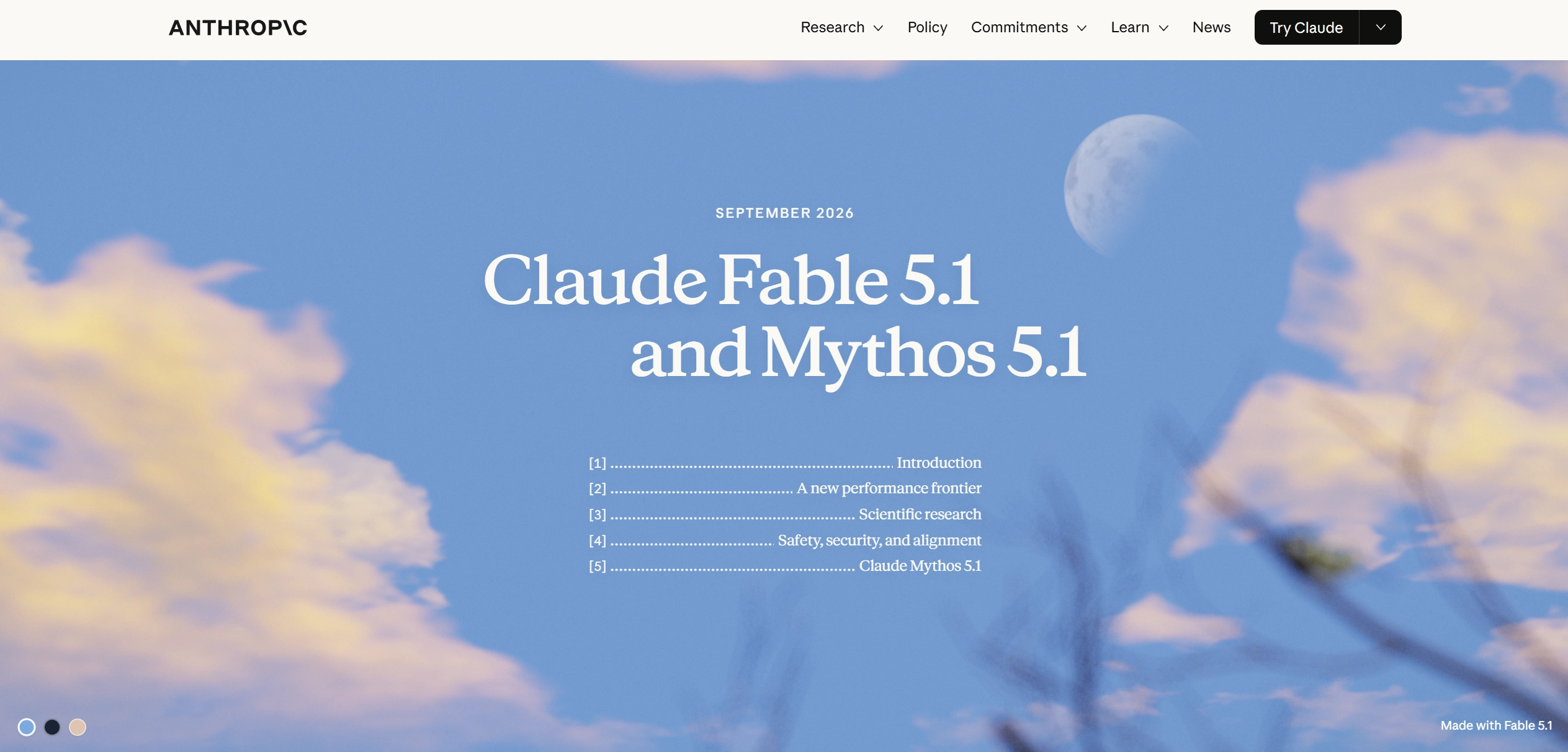
Anthropic launched Claude Fable 5.1 as a model specifically designed for demanding reasoning, long-running agentic coding, multistep research and complex knowledge work. It has a 1 million token context window and can produce up to 128,000 output tokens in one request.
Anthropic’s own examples are honestly pretty wild.
During early testing, companies reported Fable running unattended for hours, researching codebases, investigating production problems, building prototypes and verifying its own work.
Ramp described one unattended machine-learning run lasting 38 hours.
MongoDB reported a prototype where Fable researched their services and documentation, designed the solution, then ran for hours unattended while implementing and verifying it.
Those are customer-reported examples rather than controlled independent benchmarks, so I would not treat them as scientific proof of anything. But they show very clearly what Anthropic is designing this model for.
Not:
“Write me this function.”
More like:
“Here is the problem. Figure it out.”
That difference matters.
Fable 5.1 and Mythos 5.1 Are Actually the Same Model
This part is probably going to confuse a lot of people.
Claude Fable 5.1 and Claude Mythos 5.1 use the same underlying model.
The major difference is the safeguards and who can access it.
Fable 5.1 is the generally available version.
Mythos 5.1 is designed for vetted organizations and researchers who need more permissive access for areas such as advanced cybersecurity and life-sciences research.
That means Mythos is not simply a “smarter Fable.”
It is basically the same intelligence with different restrictions around what the model is allowed to help with.
And I find that direction almost as interesting as the model itself.
We may be entering a point where asking:
“What can this AI model do?”
is no longer enough.
The second question becomes:
“How much of what it can do am I actually allowed to access?”
Anthropic says Mythos 5.1 is its strongest cybersecurity model so far, although it remains within a lower risk category under Anthropic’s own framework. Mythos also gets trusted-access pathways for advanced biology and cybersecurity work.
Important side note: OpenAI and Anthropic use different risk frameworks, so their labels should not be compared directly like benchmark scores.
Fable 5.1 Also Became Cheaper for Long Agentic Work
The normal API pricing for Fable 5.1 remains:
$10 per million input tokens
$50 per million output tokens
What Anthropic changed significantly is cached input pricing.
Cache reads now cost $0.25 per million tokens, a 75% reduction from Fable 5. Anthropic estimates this can reduce typical workload costs by around 25%, and highly agentic workloads by up to approximately 45% compared with Fable 5.
That matters because agents repeatedly reuse large amounts of context.
Codebases.
Documents.
Tool outputs.
Previous instructions.
Research.
The cheaper it becomes for the model to keep referencing all of that, the more practical very long AI workflows become.
And interestingly, GPT-6 Astra’s standard API pricing is also $10 per million input tokens and $50 per million output tokens. Astra offers a roughly 1.05 million token context window and up to 128,000 output tokens.
So on headline API pricing, these two are unusually close.
Actual cost will depend much more on reasoning effort, caching, token usage and how your agent is designed.
GPT-6 Astra vs Claude Fable 5.1: Which One Is Actually Smarter?
There is no clean answer yet.
And I would be suspicious of anyone confidently telling you there is.
Here are some of the more useful currently available numbers:
| Benchmark | GPT-6 Astra | Claude Fable 5.1 | Winner |
|---|---|---|---|
| Terminal-Bench 4.0 | 57.9% | 55.8% | Astra |
| AutomationBench | 41.4% | 31.4% | Astra |
| Terminal-Bench Science 0.1 | 64.6% | 52.6% | Astra |
| FrontierMath Tier 4 | 97.6% | 87.8% | Astra |
| Humanity’s Last Exam with tools | 57.2% | 65.0% | Fable |
| Artificial Analysis Intelligence Index | ~61 | ~66 | Fable |
| Artificial Analysis Coding Agent Index | 67 | 70 | Fable |
OpenAI’s published evaluations currently show Astra ahead in areas such as agentic terminal coding, business automation, science workflows and advanced mathematics.
Independent testing from Artificial Analysis tells a more mixed story. Fable 5.1 currently leads its Intelligence Index at around 66, while Astra scores around 61. On Artificial Analysis’ Coding Agent Index, Fable 5.1 scores 70 while Astra scores 67.
[image description: Clean cropped screenshot of the Artificial Analysis GPT-6 Astra vs Claude Fable 5.1 benchmark comparison, focusing only on Intelligence Index and Coding Agent Index.]
And this is exactly why I do not like announcing a “winner” from launch-day benchmark screenshots.
Different evaluations test different things.
Different harnesses matter.
Tool access matters.
Reasoning effort matters.
Safeguards matter.
Even fallback systems matter. Artificial Analysis notes that around 4% of output tokens during its Fable 5.1 Intelligence Index evaluation were served through Anthropic’s safety fallback to other Claude models.
So yes, compare benchmarks.
Just do not mistake a benchmark table for the entire product.
I made the same point when I previously wrote about Claude Opus 4.8 and why the AI race was getting more interesting.
Real usefulness does not always perfectly follow benchmark rankings.
GPT-6 Astra’s Cybersecurity Capability Is Probably the Most Serious Part of This Launch
One part of the Astra announcement deserves its own section.
GPT-6 Astra is OpenAI’s first broadly deployed model to reach its Critical cybersecurity capability threshold under the company’s Preparedness Framework.
OpenAI says a model reaches this level when, with appropriate tools and access, it can potentially discover previously unknown vulnerabilities and develop ways to exploit well-protected systems without someone guiding every individual step.
In OpenAI’s evaluation, Astra scored 100% on ExploitBench, compared with 78.5% for GPT-5.6 Sol.
OpenAI also created a newer benchmark using recently disclosed Chrome/V8 vulnerabilities because older vulnerability benchmarks could potentially have appeared in training data.
During this evaluation, Astra reportedly discovered and used two previously unknown zero-day vulnerabilities, which OpenAI says it is disclosing to the relevant maintainers.
That is a pretty serious capability jump.
The production version has stronger safeguards and refuses certain advanced exploit-generation tasks, while OpenAI plans more permissive access for vetted defensive-security work through Daybreak.
[image description: Screenshot from OpenAI’s GPT-6 Astra safety overview showing the Critical cybersecurity capability statement. Crop tightly around the relevant section rather than using the full webpage.]
And This Creates a Weird Situation
The models are becoming more capable.
But at exactly the same time, access to those capabilities is becoming more controlled.
OpenAI has Astra with advanced cybersecurity capabilities behind safeguards and special-access programs.
Anthropic has Fable 5.1 for normal users and Mythos 5.1 for vetted users who need access to capabilities that Fable restricts.
So one of the next big AI product differences may not simply be model intelligence.
It could be permissioning.
Who are you?
What organization do you work for?
What are you trying to do?
Can the provider verify you?
Which version of the model are you allowed to access?
That is a very different future from everyone simply opening the same chatbot.
The Real Competition Is No Longer About Chatting
This is the biggest takeaway for me.
When ChatGPT originally exploded in popularity, the interaction was mostly conversational.
You asked.
It answered.
Then AI started generating images, writing code, searching the web and reading documents.
Now we are getting models designed around completely different expectations.
They are expected to stay on a task.
Use tools.
Navigate software.
Work with huge amounts of context.
Research independently.
Verify their own work.
Fix their mistakes.
And continue doing this for hours.
That is an agent.
The interface might still look like a chat box, but what is happening behind that box is becoming very different.
This also connects directly to something I wrote earlier about AI honesty and reliability becoming competitive features.
The more autonomy we give these systems, the more expensive a confident mistake becomes.
If ChatGPT gives you a slightly wrong answer, you can ignore it.
If an agent spends six hours modifying a codebase, updating records, running scripts and making decisions based on a wrong assumption, that is a different problem entirely.
What Does This Actually Mean for People Using AI for Work?
Personally, I use AI across development, marketing, research, content, documents, business operations and plenty of random things in between.
And because of that, I am becoming less interested in asking:
“Which model gives the smartest answer?”
I am much more interested in:
“Which model can I trust with the whole task?”
For development, that might mean giving an agent a bug and allowing it to inspect the codebase, reproduce the problem, identify the cause, implement the fix, run the tests and verify the application.
For marketing, it could mean researching competitors, reviewing analytics, organizing findings, working through spreadsheets and creating the first version of a campaign plan.
For business operations, it might involve CRM updates, documents, research, recurring workflows or browser tasks.
And for research, both OpenAI and Anthropic are very clearly positioning these models for increasingly complicated scientific workflows.
I previously wrote a simple guide to how I choose between GPT-5.6 Sol, Terra and Luna, because even within one AI family, different models already made sense for different types of work.
I think this is going to become even more important now.
The “best model” may simply be the wrong question.
So Who Is Winning: OpenAI or Anthropic?
Right now?
I genuinely do not think we know.
Astra looks extremely strong in computer use, automation, coding, science workflows, mathematics and cybersecurity.
Fable 5.1 looks extremely strong in independent intelligence testing, long-horizon work, research and agentic coding, while Anthropic’s Mythos strategy creates a very interesting model for trusted professional access.
And these models have barely been publicly available long enough for people to properly abuse them, stress-test them, build real workflows around them and figure out all the weird things the launch benchmarks missed.
Give it some time.
What I am much more confident about is the direction.
OpenAI and Anthropic are no longer racing only to build the chatbot that gives the best answer.
They are racing to build the AI you can hand actual work to.
And I think that is where this gets really interesting.
Because once these models can reliably work for hours, use computers, operate software, write and test code, research independently and maintain context through complicated projects, the question changes completely.
It stops being:
“What can AI tell me?”
And becomes:
“What can I safely let AI do for me?”
That, to me, is the actual GPT-6 Astra vs Claude Fable 5.1 story.
Sources Used
OpenAI, GPT-6 Astra: A new generation of intelligence
Supported Astra’s computer use, coding, benchmark, science, cyber and alignment claims.
OpenAI GPT-6 Astra announcement
OpenAI API Documentation, GPT-6 Astra
Supported API pricing, context-window size, output limits and availability details.
GPT-6 Astra API documentation
OpenAI, Safety overview: GPT-6 Astra
Supported the Critical cybersecurity classification and safeguards discussion.
GPT-6 Astra safety overview
Anthropic, Claude Fable 5.1 and Mythos 5.1
Supported launch details, agentic benchmarks, safeguards, Mythos access and cost changes.
Anthropic Fable 5.1 and Mythos 5.1 announcement
Anthropic Claude Platform Documentation, Fable 5.1
Supported pricing, 1M-token context, 128K output, release date and intended workloads.
Claude Fable 5.1 documentation
Artificial Analysis, Claude Fable 5.1
Supported independent Intelligence Index and agentic knowledge-work results.
Artificial Analysis Fable 5.1 benchmarks
Artificial Analysis, GPT-6 Astra
Supported independent Astra intelligence, coding-agent and cost-efficiency testing.
Artificial Analysis GPT-6 Astra benchmarks