A lot of Google Ads conversations start with questions like:
Why is the CPC increasing?
Should we increase the budget?
Should we add more keywords?
Should we change the bidding strategy?
Should we create another campaign?
Those can all be valid questions.
But I think there is a bigger question that needs to come first:
Is the entire system actually built to convert the traffic you are paying for?
Because Google Ads does not operate in isolation.
An excellent campaign can send traffic to a terrible landing page.
A great landing page can be connected to poor conversion tracking.
A campaign can generate dozens of leads while the sales team discovers that almost none of them are actually qualified.
And increasing the budget on that system does not fix the problem.
It usually makes the problem more expensive.
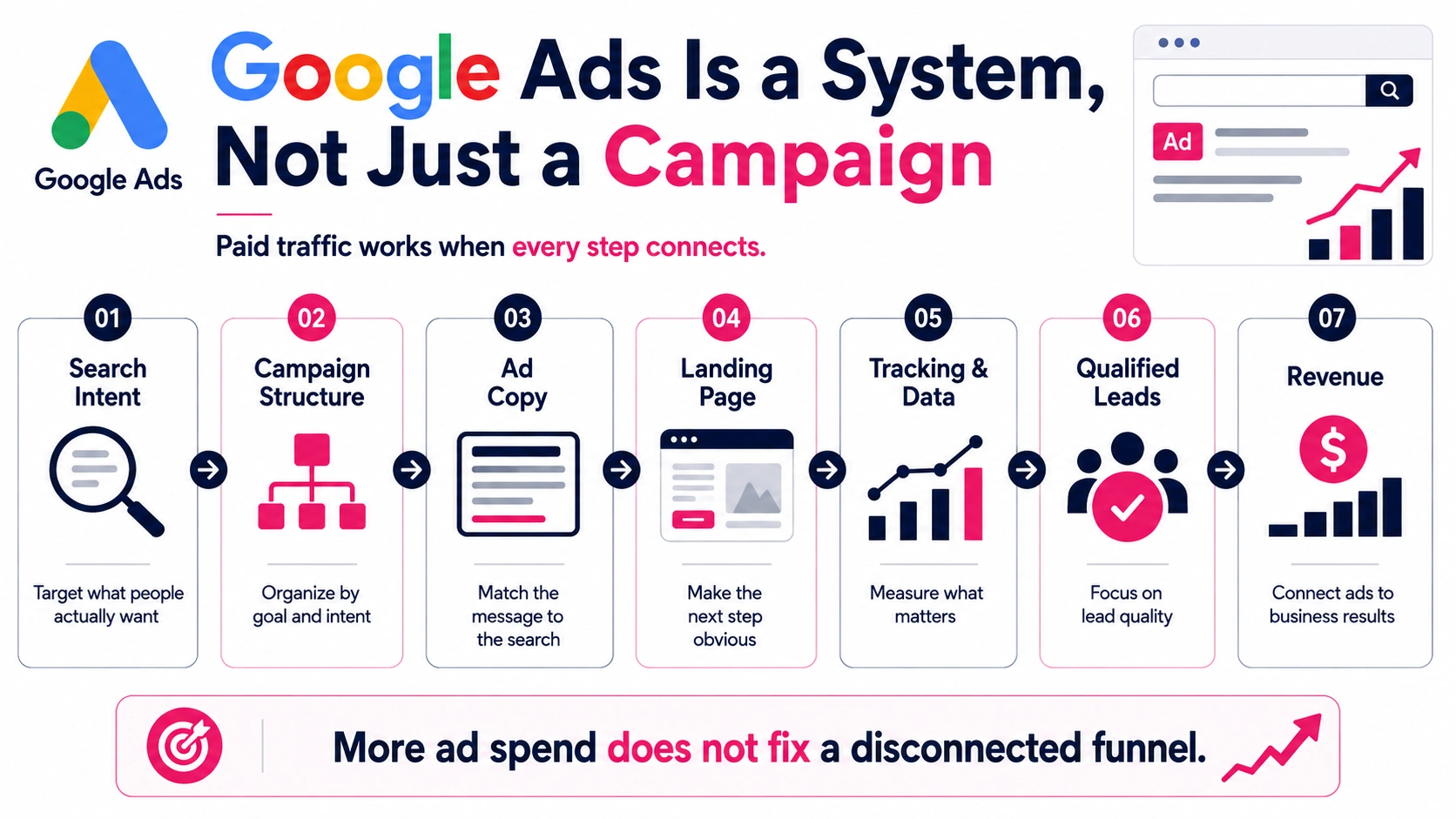
That is why I prefer looking at Google Ads as a complete growth system rather than simply an advertising campaign.
The basic journey looks something like this:
Search intent → Ad → Landing page → Conversion → Qualification → Sales → Revenue
Every part matters.
Here is how I would look at the whole system.
What Actually Makes a Google Ads Campaign Successful?
The short answer:
A successful Google Ads campaign connects the right search intent with the right offer, sends that traffic into a strong conversion experience, measures meaningful business outcomes and continuously improves based on that data.
Clicks alone are not the goal.
Traffic alone is not the goal.
And even form submissions are not necessarily the goal.
The real question is whether the advertising is contributing to something valuable for the business.
That changes how you build everything.
1. Start With Strategy Before Opening Google Ads
Before creating campaigns, I would first understand where Google Ads fits into the wider customer journey.
What happens before someone searches?
What are they searching for?
What happens after they click?
What happens after they become a lead?
Who qualifies that lead?
How does that lead eventually become revenue?
Without understanding this journey, it is very easy to optimize one small part of the funnel while ignoring the bigger picture.
For example, reducing cost per lead sounds great.
But what if reducing the cost per lead gives you significantly worse leads?
Now the Google Ads dashboard looks better while the business result gets worse.
This is why the advertising objective should connect to the actual business objective.
Before launching anything, define:
- what the business is trying to achieve
- what type of customer you want
- which products or services matter most
- what action you want someone to take
- what makes a lead qualified
- what happens after a lead enters the sales process
- how you will measure whether the campaign actually worked
This sounds basic.
But everything that follows depends on it.
2. Build Campaign Structure Around Clear Objectives
A Google Ads account should be understandable.
That sounds obvious, but campaign structures can become messy surprisingly quickly.
Products get mixed together.
Brand searches sit beside generic searches.
Different services share the same budget.
Different search intentions are grouped into one place.
And eventually it becomes difficult to understand what is actually generating the result.
I prefer campaign structures where there is a clear reason why each campaign exists.
That can mean separating campaigns by:
- business objective
- product or service
- brand and non-brand searches
- geography
- audience
- funnel stage
- campaign type
Not every account needs dozens of campaigns.
More structure is not automatically better.
The goal is simply to create enough separation that you can understand performance and make useful decisions.
Brand and Non-Brand Searches Should Usually Be Understood Separately
Someone searching directly for your company is very different from someone searching generically for a solution.
For example:
Brand search:
Acme Accounting
Non-brand search:
accounting firm for small businesses
The first person already knows the company.
The second person may be comparing several options.
Their intent, expected conversion rate, advertising value and messaging can be very different.
Combining both can make the overall numbers look better while hiding how effectively the campaign is actually acquiring new demand.
3. Search Intent Matters More Than Simply Having Keywords
A keyword tells you what somebody typed.
Intent tells you what they probably want.
That distinction matters.
Consider these searches:
- what is CRM software
- best CRM for small business
- CRM pricing
- buy CRM software
- Salesforce alternatives
They are all related to CRM software.
But the person behind each query can be at a very different stage of the buying process.
Treating them all the same usually leads to weak targeting and generic advertising.
Prioritize Searches That Match the Business Objective
For most performance-focused campaigns, I would pay particularly close attention to searches showing commercial or transactional intent.
That does not mean informational searches are useless.
They may have value in the right strategy.
But they should not automatically be treated like someone who is actively trying to buy.
The campaign structure, bid strategy, ad copy and landing experience should make sense for the intent you are targeting.
Regularly Review What People Are Actually Searching
Your keyword list is only part of the story.
The search terms report shows the searches that triggered your ads and can help you identify useful new terms as well as irrelevant searches that may need to be excluded. Google itself recommends using the report to refine targeting and add irrelevant phrases as negative keywords where appropriate.
This is one of those areas I would never treat as a one-time setup.
Search behavior changes.
New irrelevant queries appear.
New opportunities appear.
A good negative keyword list grows with the campaign.
4. Your Ad Should Continue the Search, Not Interrupt It
A person searches because they want something.
The ad should feel like the logical next step.
If someone searches for:
Shopify development agency
and the ad says:
We Deliver Innovative Digital Transformation Solutions
the advertiser might think it sounds professional.
The person searching may simply wonder whether the company actually builds Shopify websites.
Clarity normally wins.
The ad needs to answer a few questions quickly:
- Is this relevant to what I searched for?
- Can this company solve my problem?
- Why should I choose them?
- What should I do next?
Lead With a Real Benefit
Generic claims are easy to write:
- industry-leading solutions
- world-class service
- innovative technology
- customer-focused approach
The problem is that almost any company can say them.
Specificity gives the message meaning.
If there is a genuine differentiator, make it visible.
That could be:
- a specialization
- a pricing advantage
- a faster process
- a guarantee
- a geographic advantage
- a specific feature
- relevant experience
- a different business model
The exact message obviously depends on the business.
But the principle stays the same.
The ad should give the searcher a reason to choose this result instead of the other results sitting beside it.
5. The Landing Page Is Part of the Google Ads Campaign
This is one of the biggest things businesses misunderstand about paid advertising.
The campaign does not end when someone clicks.
That is where the next part begins.
If I had to diagnose a Google Ads problem, I would never look only inside Google Ads.
I would also look closely at the page receiving the traffic.
Because you can improve targeting, keywords and ads endlessly, but if the landing page creates confusion or distrust, there is a limit to what campaign optimization can solve.
The Message Should Continue From Ad to Page
If the ad promotes a specific service, the landing page should clearly show that service.
If the ad promotes an offer, that offer should be immediately visible.
If the search is highly specific, sending the visitor to a generic homepage may create unnecessary friction.
The visitor should not have to figure out whether they landed in the right place.
A Strong Landing Page Usually Makes These Things Clear Quickly
- what is being offered
- who it is for
- why it matters
- what makes it different
- why the company can be trusted
- what the visitor should do next
The main CTA should be easy to find.
The page should work properly on mobile.
It should load quickly.
And anything that unnecessarily distracts someone from the intended action should have a reason for being there.
A Google Ads landing page does not need to be minimal for the sake of being minimal.
It needs to be focused.
6. Conversion Tracking Has to Reflect What the Business Actually Values
This is where Google Ads becomes much more interesting.
Imagine two campaigns.
| Campaign | Leads | Qualified Leads | Customers |
|---|---|---|---|
| Campaign A | 100 | 10 | 2 |
| Campaign B | 50 | 25 | 8 |
If you only optimize for raw lead volume, Campaign A looks stronger.
Once you look deeper into the funnel, Campaign B becomes far more interesting.
That is the difference between tracking activity and tracking business outcomes.
Move Beyond Form Submissions When Possible
As of August 2026, Google Ads supports Qualified Lead and Converted Lead conversion goals specifically to help advertisers measure deeper stages of the lead-to-sale journey. Google says these goals can be connected to offline CRM or lead-management data so campaigns can distinguish initial leads from leads that were actually qualified or converted.
That is an important shift.
Instead of telling Google:
Find more people who submit this form.
you can potentially give it better information about the kind of people who become meaningful opportunities.
That does not mean every small business needs a complicated CRM integration tomorrow.
But the direction is important.
The closer your advertising measurement gets to actual business value, the more useful the data becomes.
7. Enhanced Conversions and Offline Data Are Becoming More Important
For businesses where the final sale happens after the website interaction, online conversion tracking only tells part of the story.
Think about:
- agencies
- professional services
- B2B companies
- high-ticket services
- businesses that close customers over the phone
- companies with longer sales cycles
Someone may submit a form today and become a customer three weeks later.
Without connecting those stages, Google Ads may know that a form was submitted but not whether that form generated anything useful.
Google’s current enhanced conversions for leads system uses first-party customer data alongside offline conversion information to improve attribution and measurement. Google currently recommends enhanced conversions for leads for advertisers implementing or upgrading offline lead measurement.
Google has also changed parts of the implementation during 2026, including updates involving Data Manager and its enhanced conversions setup, so this is one area where I would always check the latest official documentation before implementation.
The larger principle is more important than the specific technology:
Try to close the gap between advertising data and what actually happens inside the business.
8. Optimize the Funnel, Not Just the Campaign
Once the campaigns are running, optimization should not mean randomly changing things every few days.
You need to understand where the problem is.
If impressions are low, that is one type of problem.
If people see the ad but do not click, that is another.
If they click but do not convert, that points somewhere else.
If they convert but the leads are terrible, that is another problem entirely.
And if the leads are excellent but nobody closes them, Google Ads may not even be the main issue.
This is why I would look across the funnel:
Search Level
- Which searches are triggering ads?
- Which ones are irrelevant?
- Which searches consistently produce useful conversions?
- Are new negative keywords needed?
Ad Level
- Which messages get attention?
- Which messages generate better-quality conversions?
- Is the offer clear?
- Does the ad accurately represent the landing page?
Landing Page Level
- Are people understanding the offer?
- Is the CTA clear?
- Is mobile performance good?
- Are there unnecessary distractions?
- Does the page create enough trust?
Conversion Level
- Are leads actually qualified?
- Which campaigns generate the best customers?
- What is the cost per qualified lead?
- What happens after the form submission?
- Where are prospects dropping out?
That gives you something much more useful than saying:
CTR increased this month.
CTR can be useful.
But business owners cannot pay salaries with CTR.
9. Be Careful With Vanity Metrics
Metrics are not useless.
The problem starts when a metric becomes the goal instead of helping you understand the goal.
Clicks matter.
CTR matters.
CPC matters.
Impression share can matter.
Conversion rate matters.
But every metric needs context.
A cheap click from the wrong person is still wasted money.
A high CTR on misleading ad copy is not a win.
A low cost per lead means very little if the sales team cannot use the leads.
Instead of asking only:
How much does a lead cost?
I would eventually want to understand:
How much does a qualified lead cost?
Then:
How much does a customer cost?
And ultimately:
What is the business getting back from the money being spent?
Google’s own advertising guidance increasingly reflects this idea. Its current documentation encourages advertisers to define meaningful conversion goals and values so automated bidding can optimize toward outcomes that better reflect business value.
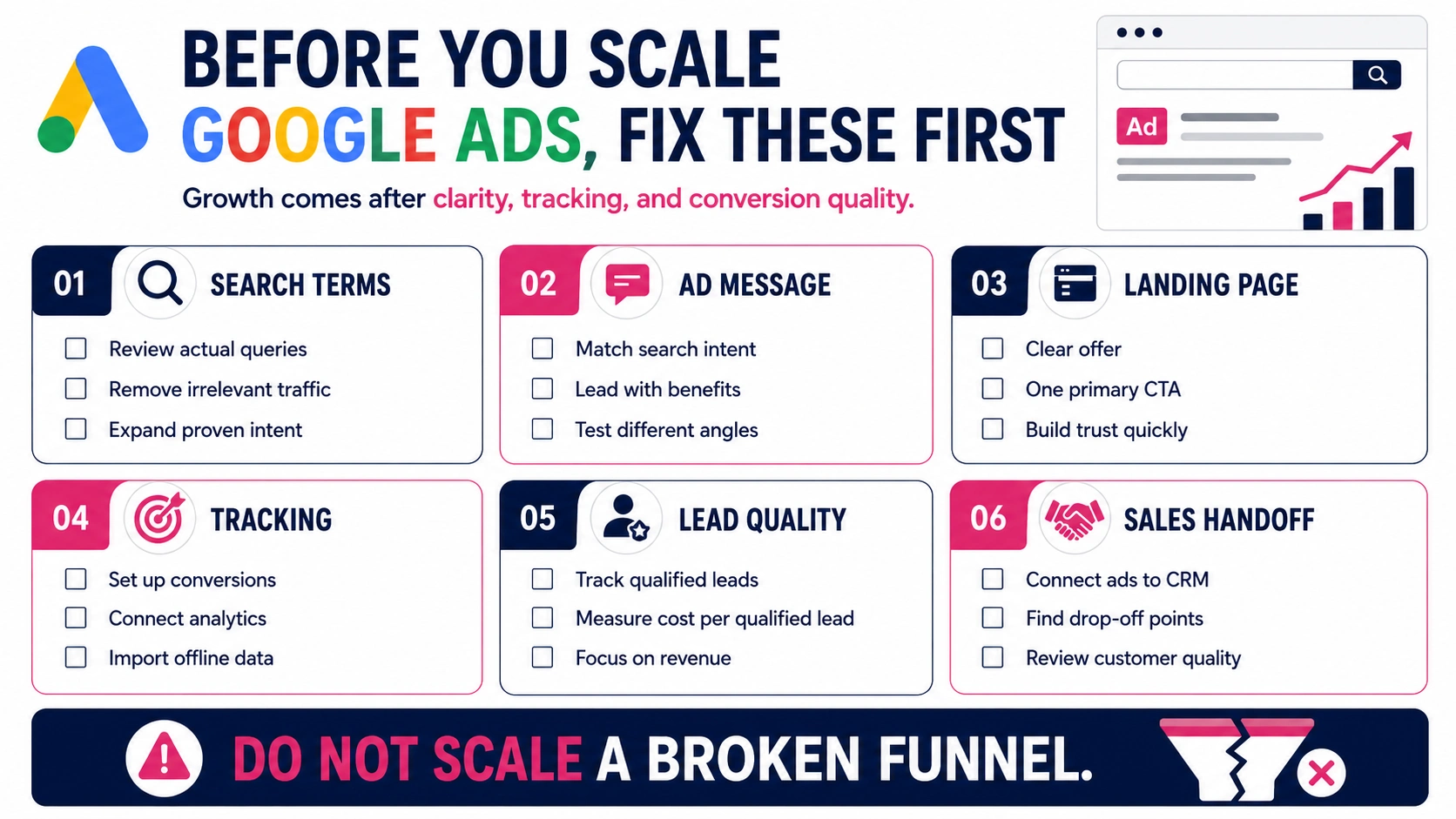
10. Do Not Scale a Broken Funnel
Increasing the budget is not automatically scaling.
Sometimes it is simply buying more of the same problem.
Suppose a campaign generates poor-quality traffic.
Doubling the budget can generate twice as much poor-quality traffic.
Suppose the landing page converts badly.
Sending more people to it increases the amount of money flowing through an inefficient page.
Suppose the lead qualification process is broken.
Generating more leads creates more work for the sales team without necessarily producing more customers.
I would scale after finding something repeatable.
That normally means there is evidence that:
- the targeting works
- the searches make sense
- the ads attract the right people
- the landing page converts
- the leads have reasonable quality
- the economics make sense
Then you have different ways to grow.
You can:
- increase budget gradually
- expand proven keyword themes
- test related search intent
- enter additional locations
- test new offers
- improve conversion rates
- test additional campaign formats
- improve the value generated from existing traffic
This is healthier than treating budget increases as the only growth lever.
11. Google Ads and Sales Should Not Live in Separate Worlds
For lead-generation businesses especially, marketing often knows what happened until the form was submitted.
Sales knows what happened afterward.
Those two datasets should eventually meet.
If the Google Ads team thinks a campaign is performing wonderfully because it generated 40 leads, while the sales team says 35 were useless, you do not have a campaign optimization problem.
You have an information problem.
The advertising system needs some way of learning what happened next.
Even without advanced automation, businesses can start asking:
- Which leads were qualified?
- Which became sales opportunities?
- Which closed?
- What revenue came from them?
- Which campaigns generated those people?
- Which services or offers produced stronger customers?
That feedback can completely change how you judge a campaign.
12. A Better Way to Review Google Ads Performance
Instead of opening Google Ads and immediately asking whether the numbers went up or down, I would review performance in layers.
| Layer | Question |
| Strategy | Are we targeting the right opportunity? |
| Search intent | Are the right people finding us? |
| Campaign | Are campaigns structured clearly enough to optimize? |
| Ad | Does the message match what people want? |
| Landing page | Does the page make the next step easy? |
| Conversion | Are visitors taking meaningful actions? |
| Lead quality | Are those conversions actually valuable? |
| Sales | Are good leads becoming customers? |
| Economics | Is the business making sense of the ad spend? |
| Scale | Can we increase volume without destroying efficiency? |
That is a much more useful Google Ads review than looking at one percentage inside a dashboard.
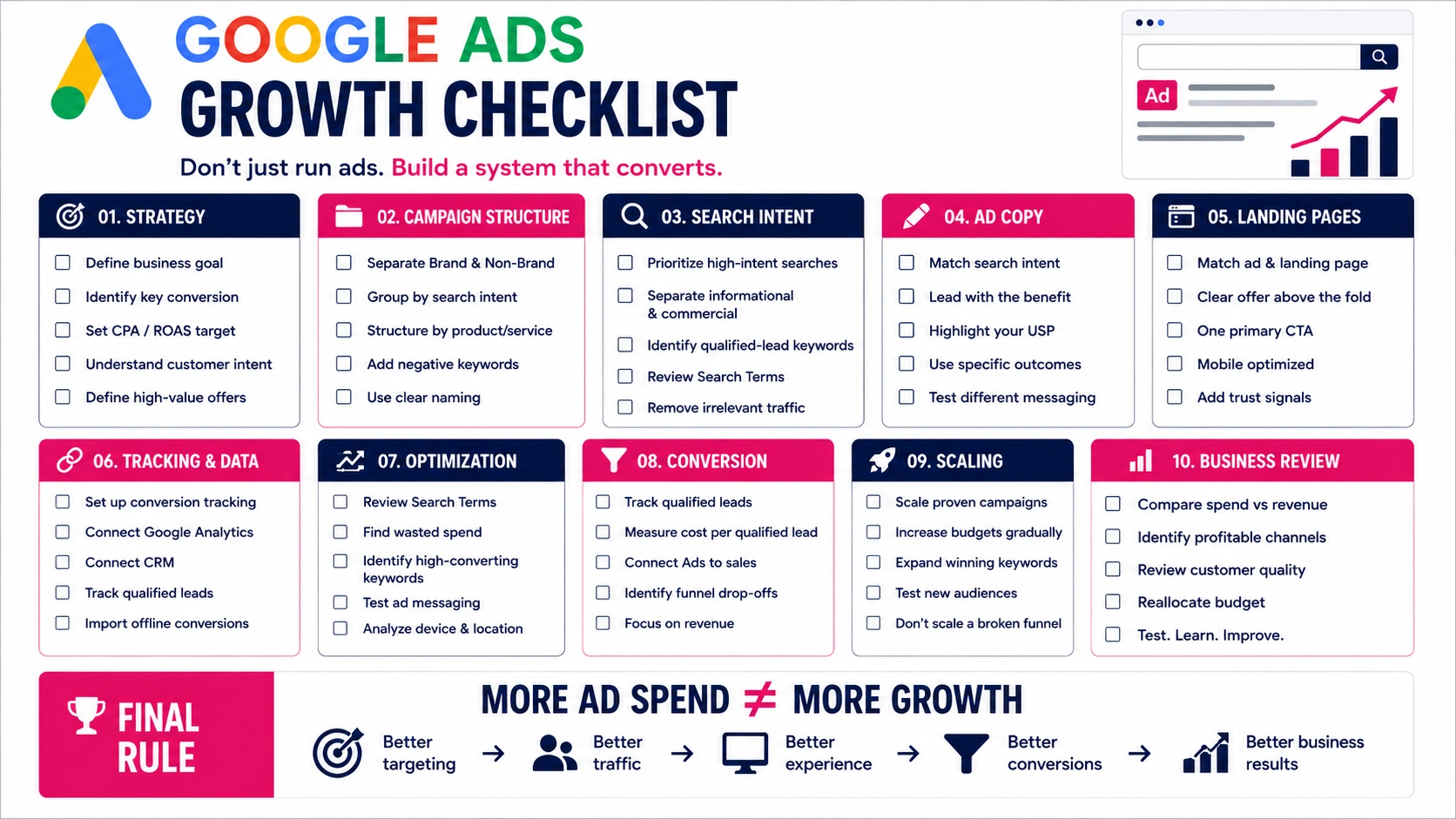
My Google Ads Growth Checklist
If I had to reduce the entire process to one audit, this is what I would check.
Strategy
- Understand where paid search fits into the customer journey
- Define the actual business objective
- Decide what a valuable conversion means
Campaign Structure
- Separate campaigns when objectives genuinely differ
- Understand Brand versus Non-Brand performance
- Group targeting around clear intent
- Maintain sensible naming and organization
- Keep unrelated audiences or offers separated when needed
Search Intent
- Prioritize searches relevant to the business objective
- Regularly inspect search terms
- Remove irrelevant traffic
- Expand around intent that proves valuable
Ads
- Match the searcher’s intent
- Communicate a clear benefit
- Explain genuine differentiators
- Give the visitor a clear next step
- Test meaningful messaging differences
Landing Pages
- Continue the message from the ad
- Make the offer immediately understandable
- Make the CTA easy to find
- Remove unnecessary friction
- Check mobile usability
- Improve speed
- Add relevant trust signals
Measurement
- Verify conversion tracking
- Connect analytics where useful
- Define qualified leads
- Connect CRM or offline data when practical
- Use deeper funnel conversion data where appropriate
- Measure outcomes the business actually cares about
Optimization
- Find wasted spend
- Identify valuable searches and keywords
- Test ad messaging
- Improve landing-page conversion
- Review device and geographic performance
- Compare lead quality across campaigns
Scaling
- Scale what has proven itself
- Increase budgets deliberately
- Expand proven intent
- Continue improving conversion rates
- Test new channels and campaign types carefully
- Never use additional budget to hide a broken funnel
The Final Rule: More Ad Spend Does Not Automatically Create More Growth
Google Ads can send traffic.
It cannot fix every problem that happens before or after that click.
If the targeting is weak, fix the targeting.
If the message is weak, fix the message.
If the landing page is weak, fix the landing page.
If measurement is incomplete, fix the measurement.
If the leads are bad, understand why.
If the sales process is leaking opportunities, look beyond Google Ads.
Then scale.
The way I see it, sustainable paid growth usually follows a fairly simple chain:
Better targeting → Better traffic → Better experience → Better conversions → Better business results
Google Ads is powerful.
But the campaign itself is only one part of the system.
Build the system first.
Then use the advertising budget to grow it.
Sources Used
Google Ads Help: Search terms report
Explains how search-term data can be used to identify useful searches and add irrelevant terms as negative keywords. Google Ads Search Terms Report
Google Ads Help: About Qualified Leads and Converted Leads
Supports the section on measuring deeper stages of the lead-to-sale funnel using qualified and converted lead goals. Qualified Leads and Converted Leads
Google Ads Help: About Enhanced Conversions for Leads
Supports the explanation of enhanced conversions for leads and connecting first-party and offline lead data. Enhanced Conversions for Leads
Google Ads Help: Updates to Enhanced Conversions Settings
Used to verify the 2026 changes to enhanced conversions and Data Manager implementation. Enhanced Conversions Updates
Google Ads Help: Performance Max and Conversion Value Guidance
Supports the principle of aligning conversion measurement and bidding with actual business value. Google Ads Conversion Value Guidance